02 · Article
On this page15 sections
- The decision loop is the real product
- What I build into every fast launch
- The anti‑feature list
- How feedback actually changes the product
- Why this works for AI products
- The real takeaway
- The version of speed I care about
- The role of constraints
- The “good enough” bar
- The long game
- The compounding effect
- The discipline that keeps it sustainable
- Related Guides
- Related Stories
- Learn More
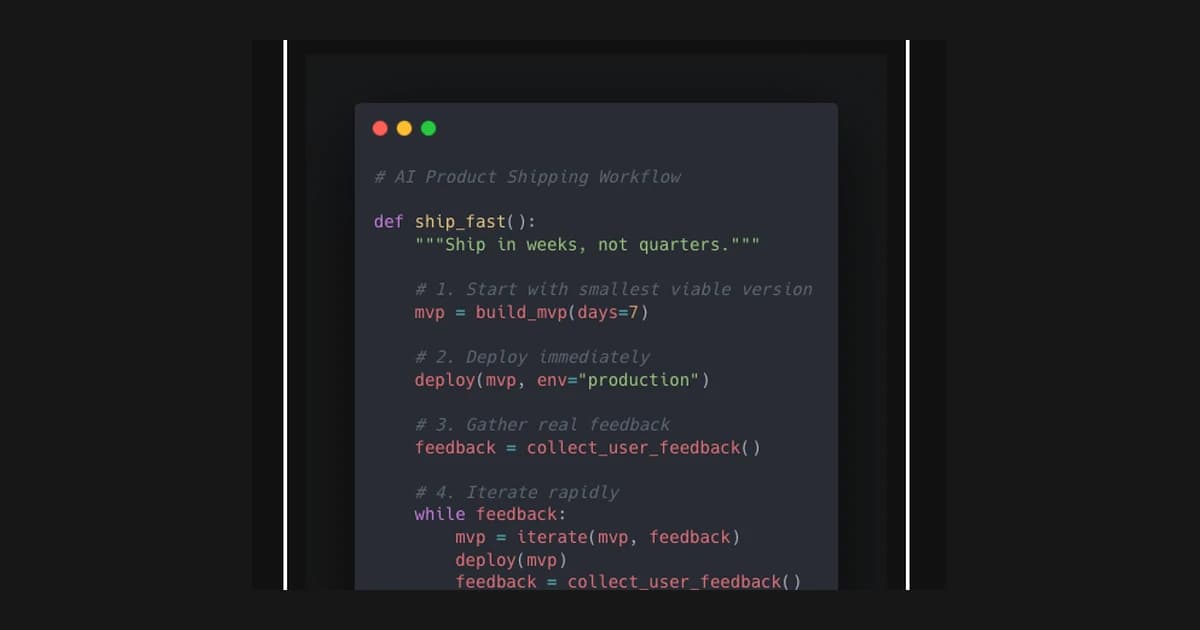
The traditional product development cycle doesn't work for AI products. By the time you've gone through months of planning, research, and development, the landscape has completely changed. New models have been released, new capabilities have emerged, and your original assumptions may no longer be valid.
I've adopted a different approach: ship in weeks, not quarters. This means starting with the smallest possible version of an idea, getting it in front of users immediately, and iterating based on real feedback rather than assumptions. The key insight is that with modern AI APIs and frameworks, the bottleneck is no longer implementation time - it's decision-making time.
The methodology breaks down into three phases. First, the 48-hour prototype: build something users can actually interact with, even if it's rough. Second, the one-week MVP: refine based on initial feedback and add the minimum features needed for a useful product. Third, the two-week launch: polish, add monitoring, and ship to production. This tight timeline forces you to ruthlessly prioritize and avoid over-engineering solutions to problems that may not exist.
The decision loop is the real product
Shipping in weeks only works if the decision loop is tight. That means:
- a clear hypothesis you can test quickly
- a simple onboarding path
- a single metric that tells you if the idea is alive
If you do not define the loop, you will spend the week polishing features that never mattered. The loop keeps you honest.
What I build into every fast launch
There are a few pieces I ship even in the smallest version:
- basic analytics (so I can see intent, not just traffic)
- error tracking (so the product can survive real users)
- a feedback capture path (so the next iteration is obvious)
These are not “nice to haves.” They are the minimum scaffolding that makes rapid iteration possible.
The anti‑feature list
The hardest part of shipping in weeks is deciding what not to do. I keep a running anti‑feature list, and I treat it as part of the plan:
- no edge‑case handling in v1
- no advanced customization until the loop is proven
- no fancy UI unless it removes friction
If a feature does not reduce time‑to‑value, it gets deferred.
How feedback actually changes the product
Fast shipping is not just speed. It is speed with discipline. The feedback loop I use looks like this:
- Ship the smallest useful thing
- Watch for repeated confusion points
- Fix the confusion before adding anything new
- Repeat until the loop is stable
This is why I prefer weeks, not quarters. A quarter gives you time to ignore feedback. A week forces you to act on it.
Why this works for AI products
AI products change fast. Models evolve, user expectations change, and competitors can copy features in days. The only durable edge is how quickly you can learn and adapt.
Shipping in weeks creates that edge. It turns product development into a live experiment rather than a long speculation cycle.
The real takeaway
The goal is not to ship more. The goal is to learn faster. When you learn faster, you make better product decisions. That is the entire advantage.
If you want to move quickly in AI, reduce the size of each bet and increase the number of feedback loops. That is how you win without burning months on the wrong idea.
The version of speed I care about
Speed is not just how fast you ship a feature. It is how fast you can learn what is true. That means your release cadence and your feedback cadence are the same thing. If a product takes weeks to ship, it will take months to learn. If you can ship in days, you can learn in weeks.
This is the reason I obsess over short cycles. It is not a productivity hack. It is the only way I know to prevent building the wrong thing at full quality.
The role of constraints
Constraints are not limits. They are guardrails. When I give a product two weeks, it forces a conversation:
- What problem is really being solved?
- What is the smallest proof that this is real?
- What work can wait until the signal is clear?
Without that constraint, teams default to building nice‑to‑haves and treating speculation as roadmap.
The “good enough” bar
The biggest mistake in fast product cycles is aiming for polish too early. The goal is not to impress. The goal is to prove.
For me, “good enough” means:
- it runs reliably
- the value is obvious within minutes
- the feedback path is clear
If those three are true, you can ship. Everything else is a second‑order improvement.
The long game
Shipping in weeks is not a one‑off tactic. It becomes a culture. Teams that can move fast early tend to keep that speed because they build the systems to support it: a lean backlog, tight release processes, and a bias toward proof over polish.
That culture is the real advantage. It compounds over time.
If you are building in AI, you cannot afford to wait a quarter to learn if your bet was right. Ship small, learn fast, and let proof drive the roadmap.
The compounding effect
The advantage of short cycles is compounding. Every week you ship is another week of feedback you can integrate. Over a year, that gap becomes massive compared to a team shipping quarterly.
This is the reason I still believe “weeks, not quarters” is the only viable strategy for AI products. The market moves too quickly for long speculation cycles.
The discipline that keeps it sustainable
Speed without discipline burns teams out. The way I avoid that is to make the process repeatable:
- same launch checklist
- same definition of success
- same feedback capture loop
When the process is stable, the speed becomes sustainable.
Related Guides
- How to Ship AI Products Fast — The 2-3 week playbook
- AI MVP in One Week — Day-by-day plan for a 7-day sprint
- Solo Founder AI Stack — Compete with agencies using a lean stack
Related Stories
- Shipping an iOS App Solo in 2026 — 24 days from idea to App Store
- Building in Public: Lessons from NextGame — What I learned shipping in the open
Learn More
For a complete shipping system, join the AI Product Building Course.