02 · Article
On this page20 sections
- The architecture in plain words
- The core agents
- The specialized agents
- The cost math that makes it work
- How I keep it sane
- A typical day with agents
- The supervisor is the difference
- Failure modes and guardrails
- Verification over vibes
- What changed in my day
- What this is not
- Where agents still fall short
- The ROI I care about
- The tools that make it possible
- How to start if you want this
- If I had to rebuild it today
- The real takeaway
- Related Guides
- Related Stories
- Learn More
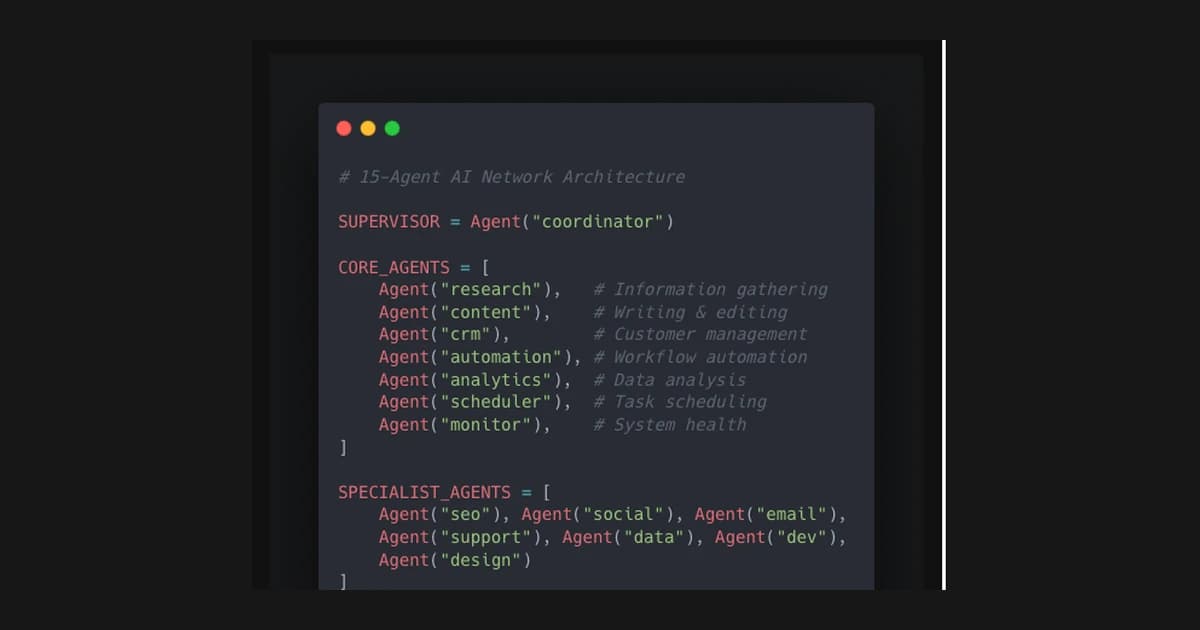
I run 15 AI agents every day. It sounds like a flex until you see the workflow.
One supervisor. Seven core agents. Seven specialized agents. Around 75 tools wired into a single system. This is not a demo or a hobby project. It is how I actually work.
I built it because I was drowning in tasks that did not deserve human attention. Research, formatting, summaries, repetitive ops, and all the little chores that steal focus from real work. The agents are there to clear that noise.
The architecture in plain words
I treat the system like a small company with a strict manager.
The supervisor routes tasks. If a task is research, it goes to the Research Agent. If it is a draft, it goes to the Content Agent. If it is a pipeline update, it goes to the CRM Agent. The supervisor does not do the work. It decides who should.
That separation matters. Without it, everything becomes a vague blob of AI output. With it, I can expect consistent results and know where to look when something is off.
The core agents
These handle the recurring work that every project needs:
- Research Agent: web search, data gathering, source checking
- Content Agent: writing, editing, formatting
- CRM Agent: lead tracking and follow ups
- Outreach Agent: personalized emails and DM drafts
- Planning Agent: calendar support and scheduling logic
- Resources Agent: file management and organization
- SWOT Agent: analysis and strategy framing
Each agent has a narrow job description. That is the whole point. If an agent tries to do too much, quality drops fast.
The specialized agents
Specialized agents handle the tasks that require domain knowledge. Code review. Design feedback. Data analysis. Anything that is too specific for a general agent but still repeatable.
I only add a specialized agent when a task keeps repeating and the cost of context switching gets annoying. If it happens once, I just do it. If it happens every week, it deserves an agent.
The cost math that makes it work
The cost is surprisingly low. A research query runs around $0.02. A content draft lands near $0.15. A CRM update is closer to $0.01 per record.
Monthly total for all 15 agents stays low enough to be practical. That is less than one hour of a junior developer for work that runs around the clock.
The system scales because the expensive part is clarity, not compute. Once the inputs and outputs are defined, the cost stays flat while the output grows.
How I keep it sane
Multi agent systems can become chaos fast. I keep it sane with a few rules:
- Narrow scope for every agent
- Templated inputs and outputs
- A single log trail I can audit
- Human review for anything that leaves the machine
If an agent sends an email or updates a record, I see it first. Anything external has a human gate.
The goal is not full autonomy. The goal is a clean handoff.
A typical day with agents
A normal day starts with a short list. I write down the tasks I want to move today. Some are research. Some are drafts. Some are updates. I feed the list into the supervisor and it routes the tasks to the right agents.
By the time I sit down with coffee, I already have a research summary, a few draft paragraphs, and a structured plan for what needs my attention. I review the output, mark what is usable, and kick back the rest for a second pass.
The system is not magic. It is thorough. Codex takes its time on the first pass so I can do the last mile with energy instead of frustration.
The supervisor is the difference
Without a supervisor, you just have a pile of tools. With a supervisor, you have a system. The supervisor makes sure each agent stays in its lane and the work comes back in a predictable shape.
It also gives me control. I can override routing, ask for a second opinion, or pause an agent mid task. That control is what keeps the system from feeling like a black box.
Failure modes and guardrails
Agents fail in predictable ways. They can overreach, misread context, or confidently summarize the wrong source. That is why the guardrails matter.
I keep prompts tight. I force sources where possible. I prefer short outputs with citations over long outputs with confidence. If a task touches external systems, it waits for my approval.
I do not let agents write and send. They write and wait. That is the difference between a helpful assistant and a liability.
Verification over vibes
The more agents you run, the more important verification becomes. I want a paper trail I can trust. Every agent response is logged. Every decision is traceable. If something feels off, I can follow the trail back to the source.
This is how you keep a multi agent system honest. Trust is earned through receipts, not through vibes.
What changed in my day
The most visible change is time. The system gives me first drafts, research summaries, and structured plans before I even open a tab. I do the last mile. I edit, decide, and ship.
That means I spend more time on strategy and relationships, less time on busywork. I still do the work that matters. I just do it with a tighter loop and less friction.
What this is not
This is not me replacing humans. It is me removing low value tasks so I can focus on high value work. The agents are not my team. They are my assistants.
If a task requires judgment, I do it. If a task requires context, I do it. If a task is repeatable and boring, I hand it off.
Where agents still fall short
Agents are not good at taste. They can draft a structure, but they do not know what feels right to a real human. They can summarize, but they do not feel the stakes of a relationship. That is why the final pass stays with me.
They also struggle with edge cases. Anything messy, emotional, or ambiguous needs a human brain. That is fine. I do not need the agents to be perfect. I need them to remove the first 70 percent of the work so I can spend my energy on the last 30 percent that actually matters.
The ROI I care about
The best return is not speed, it is focus. When I do not have to context switch every ten minutes, I make better decisions. I ship cleaner work. I do not burn out on the small stuff.
That is what the system gives me. It is a buffer between me and the noise.
The tools that make it possible
The stack is simple. MCP handles integrations. Claude API handles reasoning. Custom skills keep each agent narrow and reliable. The rest is just wiring and a lot of careful prompts.
The tooling is not the hard part anymore. The hard part is defining what you actually want.
How to start if you want this
Start small. Pick one task that happens every week and design a single agent around it. Give it a narrow brief and a clear output. Then add guardrails.
If it works, add another. If it fails, tighten the scope. Do not add a second agent until the first one is reliable.
That is how the system grows without collapsing under its own complexity.
If I had to rebuild it today
I would still start with the same three things: a supervisor, a clear naming scheme, and a single log. The supervisor keeps the work clean. The naming keeps the mental model simple. The log keeps the system honest.
Then I would build only the agents I need this month. It is tempting to design a full org chart on day one, but that is how you end up with unused bots and vague outputs. The system should earn its complexity.
The real takeaway
Agents are cheaper than employees for defined, repeatable tasks. That is the boring truth. The interesting truth is what that enables.
Clarity is the fuel. Without it, the system just churns and you end up managing outputs instead of shipping. I learned that the hard way.
When you strip away the busywork, you get space. Space to think. Space to build. Space to do the work that actually changes your business.
That is why I keep building the network.
If you are overwhelmed, start with one agent that writes a daily summary and one that drafts the boring emails. That small shift will show you the leverage fast. You can build the rest later.
If you are curious about building your own, start with one. The rest will follow. That is the whole game for me right now.
Related Guides
- AI Agents for Solo Founders — Build a 24/7 team
- AI Agents Setup Guide — Patterns, stacks, and guardrails
- Overnight AI Builds Guide — Ship more while you sleep
Related Stories
- Running 15 AI Agents Daily — Architecture and costs
- How I Built 14 AI Agents — The journey from one to many
Learn More
For the complete agent system, join the AI Product Building Course.