02 · Article
On this page9 sections
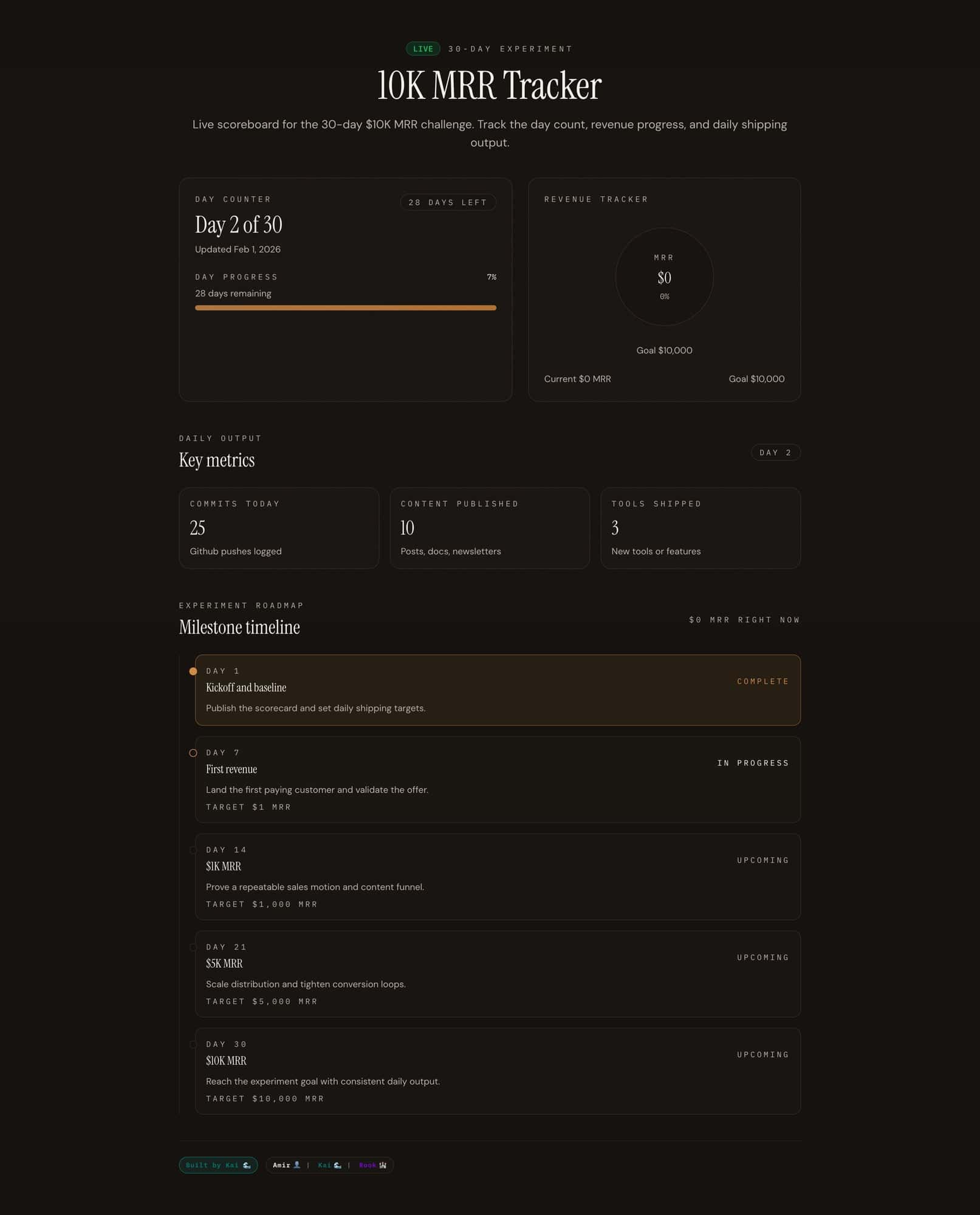
Week 1 ended with a clear gap: building was not the same as revenue.
Three application foundations were working in local development. On one documented build day, their primary repositories recorded 153 commits in total. At that point deployment was still pending and the experiment had produced $0 in new recurring revenue.
This retrospective separates those facts from the ambition around them.
Why I ran the experiment
The experiment set a public constraint:
- 30 days
- a $10K MRR target
- agent-assisted product work
- open notes about what worked and failed
The target was a goal, not a forecast or a result. I wanted to test whether a more structured agent workflow could shorten the path from an idea to a reviewable application foundation.
What existed in week 1
AgentPersonalities
A marketplace foundation for SOUL.md personality files describing capabilities, tone, and boundaries.
PromptDuels
A prompt-comparison foundation with duel and rating mechanics.
TaskBounty
A task-and-reward foundation for agent-visible work.
The three concepts were intended to explore related mechanics. Their connection was still a hypothesis, not a validated ecosystem.
What the repository evidence shows
On 4 February 2026, the three primary repositories recorded:
- AgentPersonalities: 45 commits
- PromptDuels: 68 commits
- TaskBounty: 40 commits
- Total: 153 commits
This count is bound to those repositories and that Melbourne calendar day. It shows implementation activity. It does not prove deployment, production readiness, users, or commercial outcomes.
What worked
Clear agent assignments
Small scopes, explicit file areas, and frequent checkpoints made parallel work easier to review.
Shared architecture
Using Next.js and Convex across the foundations reduced repeated setup decisions and made patterns easier to compare.
Workflow-first prototypes
The work focused on the core interaction loops and local build health before visual polish.
What had not worked yet
No deployment meant no user evidence
Without a deployed product, there was no external onboarding, activation, reliability, or retention evidence.
More code created more review
Fast implementation made feature creep easier. Every additional surface also created more testing and product decisions.
Building was more comfortable than selling
The week produced implementation artifacts, but not a distribution loop or paid commitment. The experiment needed to move beyond the repository.
The cost categories
Even before deployment, the work required:
- model usage
- development infrastructure
- task specification and coordination
- testing and human review
- attention split across three products
I did not keep a complete billing ledger for this period, so this retrospective does not attach precise cost or return-on-investment figures to the week.
The historical offer context
During the experiment, I was also testing an AI Development Sprint offer. Its proposed tiers and timelines were part of the February 2026 commercial experiment, not completed-engagement medians or current pricing.
Current offer decisions belong to the live Services and Contact pages.
Week 2 priorities
The next stage needed to establish evidence outside local development:
- deploy one foundation deliberately
- onboard external users
- track whether the core workflow was completed
- collect feedback before expanding scope
- test whether anyone would pay
The hard truth
Repository activity can feel like success, but it is only one part of delivery. Week 1 established local foundations and a coordination method. It did not establish product-market fit, production reliability, or recurring revenue.
That gap was not a footnote. It was the central result of the week.